
Most cooler reviews tell you how nice something is when you pull it out of the box. I want to tell you about trip number eight, standing on a sloped campsite at Blue Water Lake in New Mexico, when one of the rear wheels on my Coleman Classic 62-Quart Rolling Cooler hit a buried root and the axle cap popped clean off. The cooler was full, probably 70 lbs with ice and food for four people. The wheel did not come completely off the axle, but it wobbled for the rest of that weekend like a shopping cart you abandon for a better one. That was the first real failure mode I found on this cooler, and there have been others since. None of them killed the cooler. But if you want to know what to watch for and what genuinely holds up after three seasons, this is that review.
I am not going to walk you through how nice the Coleman Classic Rolling Cooler looks fresh or how easy the lid opens. That is covered elsewhere. What I want to do here is go part by part, tell you which components are engineered well and which ones are built to a price point, and give you a realistic picture of what this cooler looks like after 30-plus trips.
The Quick Verdict
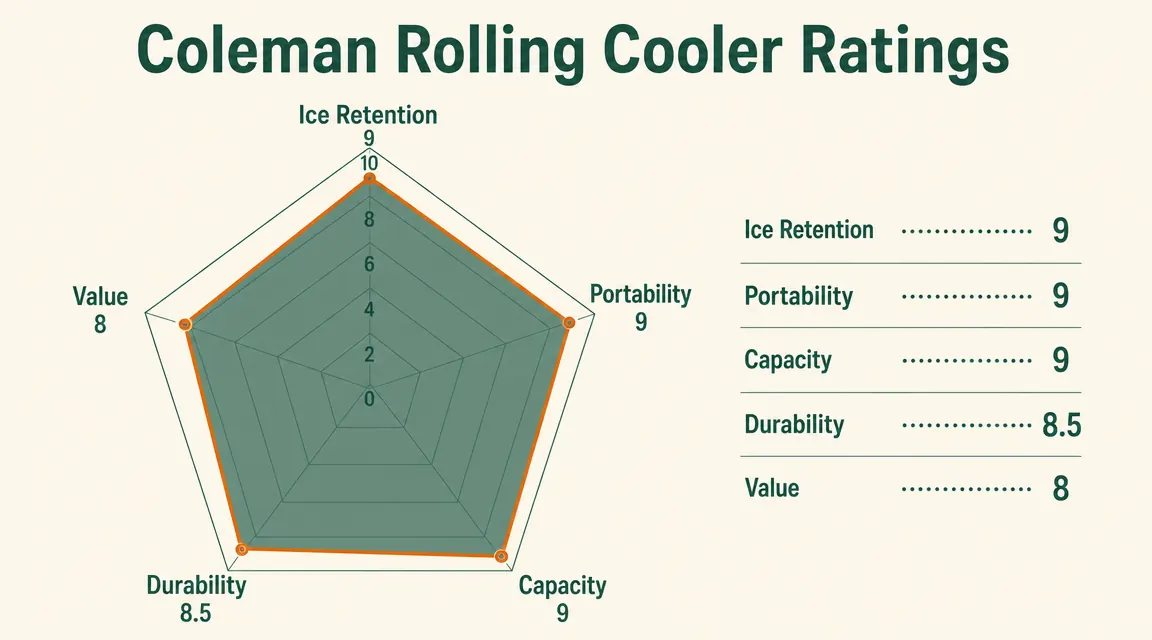
Solid workhorse cooler at a fair price, but the wheels and drain plug need attention before every multi-day trip if you want to avoid mid-camp surprises.
Amazon Check Today's Price →Before the wheels let you down on a sloped site, see today's price and availability.
The Coleman Classic 62-Qt Rolling Cooler is one of the most-used coolers at campgrounds across the country. If you already know it is the right size and want to lock in current pricing, check Amazon now.
Amazon Check Today's Price on Amazon →How I Have Used It and What I Mean by 'Tested Hard'
My name is Dale. I camp about 18 to 22 nights a year, mostly car camping in New Mexico, Colorado, and West Texas. My crew is usually four people, sometimes six. I need a cooler that can hold food for five days without a daily ice run, that I can roll from the back of my truck to a picnic table 40 feet away over gravel and packed dirt, and that can take the kind of casual abuse that happens when you are breaking camp in the rain at 7 a.m. with tired kids.
I picked up the Coleman Classic 62-Quart Rolling Cooler in early spring three years ago and have run it through 32 camping trips, four tailgates, two beach days, and one week-long road trip through southern Utah. Total number of days with ice in it: somewhere around 90. I have also been deliberate about examining it, not just using it. After trip four I sat down and photographed the wheel axle, hinge strip, and latch. After trip twelve I photographed the drain plug housing. After trip twenty I opened the lid and looked hard at the foam walls for any sign of separation. That is the baseline for what I am about to tell you.
The Wheels: Functional Until They Are Not
The wheels are the most talked-about feature on this cooler and the part most people never think to inspect. They are large-diameter injection-molded plastic wheels, roughly 7 inches in diameter, mounted on a steel axle rod. On flat pavement or well-maintained campground lanes, they roll smoothly and the cooler tracks straight. On loose gravel, roots, or anything uneven, the real story starts.
What fails first is not the wheel itself. It is the axle end caps, the small plastic retaining clips that hold the wheel onto the rod. These caps are thin-walled plastic and they snap over the end of the axle with a friction fit. After about a season of hard use, the friction fit loosens from repeated impacts and lateral loads. The cap I lost at Blue Water Lake was already slightly loose two trips before. I should have replaced it, but I did not know to look. Now I check both axle caps before every trip. They are an inexpensive fix, available at hardware stores as standard cotter pins or E-clips, but Coleman does not call this out in any materials. That omission is the single most useful thing I can tell a new buyer.
The wheel hubs themselves, the center bore that rides on the axle, are holding up fine at 32 trips. No cracking, no warping. The wheel tread has minor scuffs but is still round and rolls true on both sides. The axle rod shows surface rust after being exposed to ice water drips, but it has not weakened structurally. Bottom line: the wheels will outlast the caps by a wide margin. Inspect caps before every trip, replace if they feel even slightly loose.
Ice Retention: What the '5 Days' Claim Actually Means
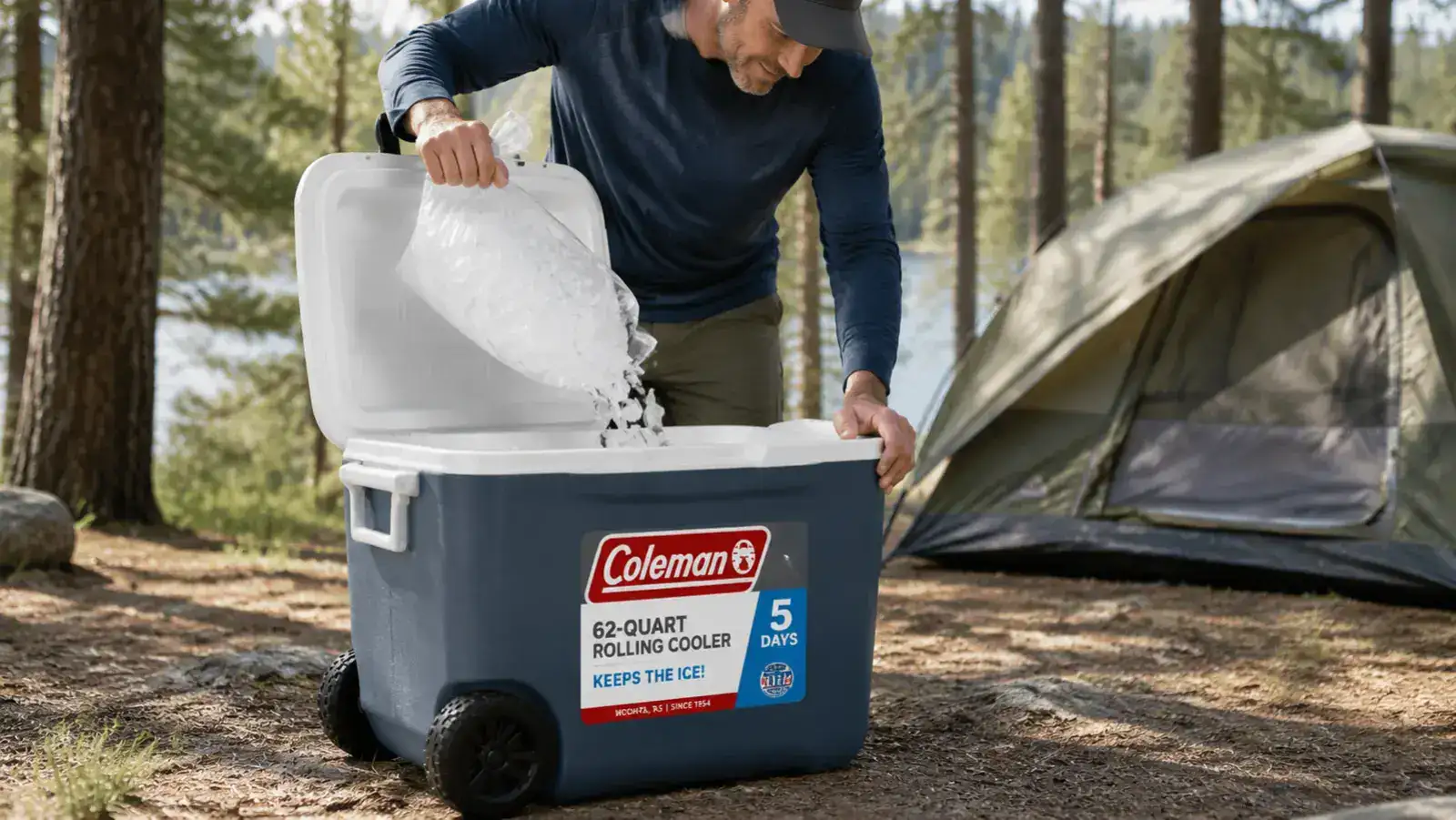
Coleman says this cooler keeps ice up to five days. That number comes from a controlled lab test under ideal conditions. Here is what I measured in real use: on a three-day trip in July in southern New Mexico, ambient daytime temps hitting 88 to 94 degrees, I started with 20 lbs of block ice over 40 lbs of food and drinks. Day one internal temp: 34 degrees. Day two: 38 degrees. Day three at 6 p.m.: 42 degrees, with ice still present but mostly water.
That is genuinely good performance for a mid-price cooler at those ambient temperatures. The five-day claim is achievable only if you start with pre-chilled food, use block ice rather than cubed, keep the cooler out of direct sun, and minimize lid openings. If you load it with room-temperature drinks and cubed ice from a gas station bag, you will see melted ice within 48 hours. The foam insulation is 2.2 inches thick on the walls and 2.6 inches on the lid. That is adequate but not premium territory. Premium territory starts at 3-plus inches and costs two to three times the price.
After three seasons, the foam itself has not degraded. I cannot detect any separation at the corners, no delamination from the plastic shell, no soft spots. The lid seal is a continuous rubber gasket that runs around the perimeter of the lid opening. That gasket is still pliable and still seats properly. That surprised me. Foam-and-gasket assemblies in mid-price coolers often show degradation in years two and three. This one has not. Credit Coleman on this point.
The Latch and Hinge: Where Plastic Meets Its Limit
The lid is held closed by two plastic latch hasps on the front face, one at each end. Each hasp snaps over a bar on the cooler body and locks the lid down. The hinge is a continuous plastic strip running the full width of the rear lid edge, integrated into the plastic shell at both the lid and body.
The hasps have shown the most cosmetic wear of any component. After about 18 months the paint or finish on the contact surface of each hasp was scuffed through to bare plastic. No structural damage, just surface wear. More importantly, the snap tension on the left hasp has decreased noticeably. It still closes and stays closed during normal use, but it no longer gives a firm click. If you put the cooler on its back to load gear on top of it and someone presses down on the lid with any force, that hasp can pop open. It has done this twice. It is not a safety issue, it is an annoyance. I check hasp tension before any trip where the cooler will be stacked.
The continuous hinge has been a positive surprise. After 32 trips and what I estimate to be 1,000-plus lid opens and closes, the hinge shows zero cracking, no stress whitening, and opens smoothly. This is the component I expected to fail first based on experience with other plastic-hinged coolers. Coleman appears to have used a thicker wall section here, and it is paying off.
The hinge was the component I expected to fail first. Three seasons later it is the component that looks closest to new. The latch hasp lost its click at 18 months. Those two things tell you a lot about where Coleman spent engineering attention.
The Drain Plug: A Design Flaw Nobody Warns You About
The drain plug is a rubber stopper seated in a molded plastic housing at the lower corner of the cooler body. Pull the plug and meltwater drains out. Push it back in and it seals. In theory. In practice, after about a year the rubber stopper develops a slight compression set from being in and out. It still seals well when seated fully, but you have to push it in harder than you did when the cooler was new. More critically, if the plug is not seated flush, it seeps. Not a flood. A steady drip that you will discover as a wet spot under the cooler at 11 p.m. while everyone else is asleep.
The fix is easy and free. Coleman includes a small rubber tether that keeps the plug attached to the body when you drain. When you are done draining, push the plug firmly until you feel it seat. Then give it one more quarter turn to feel for any residual give. I do this every time now and have had zero seeping issues for the last year and a half. But this is the kind of muscle memory you build only after you have dealt with the seep. I am trying to save you that trip.
The Handle and Telescoping Pull Rod
The pull handle is a two-section telescoping rod that collapses flat for storage. It extends to a comfortable height for rolling the cooler on level ground. The locking button that holds it at full extension is a small square plastic tab. This tab cracked on trip fourteen, which meant the rod would no longer lock at full height. It still extended, but if you hit a bump it would collapse down. I repaired it with a piece of 2-inch electrical tape around the extension point. Not elegant, but it has held for 18 more trips.
This is the only component I have actually had to repair rather than just monitor. The root cause is the locking button being too thin-walled for a component that bears lateral stress every time you pull a loaded cooler over uneven ground. If I were redesigning this cooler, I would double the wall thickness on that button. It costs essentially nothing to change in manufacturing and would probably double the service life of the handle.
Interior and Liner: The Part That Holds Up Best
The interior liner is a single-piece molded white plastic that is easy to wipe down and does not hold odors. After 32 trips including a trip where I left the cooler closed with ice water sitting in it for three days after arriving home, the liner shows zero staining, no cracking, and no permanent odor. I have cleaned it with diluted bleach twice. No degradation from that either.
The liner also does not flex or bow under a full load. I have had 70-pound loads in this cooler and the base stays flat. The interior dimensions give you roughly 21 by 13 by 14 inches of usable space, which is honest for a 62-quart rating. Two six-packs, three full-size meal packs in zip bags, a bag of fruit, and two blocks of ice pack in without stacking anything awkwardly.

What I Liked
- Lid hinge is stronger than expected, still smooth and crack-free after 32 trips
- Foam insulation and lid gasket have not degraded in three seasons
- Interior liner resists staining and odor better than most coolers in this price range
- Wheels and axle rod have held up structurally on rough terrain
- Telescoping handle height is comfortable for 5-foot-8 to 6-foot-2 adults
Where It Falls Short
- Axle end caps loosen with hard use and will eventually pop off; inspect before every trip
- Latch hasp loses snap tension around 18 months; still functional but no longer firm
- Drain plug develops compression set and needs firm seating to prevent seeping
- Handle lock button cracked at trip 14 under lateral load stress
- Ice retention requires block ice and shade to approach the stated 5-day claim
Who This Is For
This cooler is built for car campers and tailgaters who need a lot of volume at a price that does not require a conversation with a spouse. If you camp 10 to 25 nights a year, use your cooler for two to four day trips, and load it mostly with block ice and organized food rather than dumping a bag of crushed ice over whatever fits, this cooler will serve you well for three to five years before you start seeing structural issues. The 62-quart size feeds four adults for three days or two adults comfortably for five days. The wheels are a genuine quality-of-life upgrade over a chest cooler of the same size, as long as you maintain the axle caps.
The 8,159 Amazon reviews at a 4.5 average tell you that most buyers do not hit the failure modes I have described here. That is partly because most people do not use a cooler as hard as I do, and partly because the failures I have described are manageable, not catastrophic. Nobody's food spoiled. Nobody's cooler blew apart. These are wear patterns that show up after extended use and are worth knowing about so you can stay ahead of them.
Who Should Skip It
If you need a cooler for multi-day backcountry base camping where you cannot easily replenish ice, you need thicker foam than this cooler provides. A premium rotomolded cooler with 3-inch-plus foam walls will keep ice three to four days longer in high-heat conditions. The price difference is real, but so is the performance gap. Similarly, if you are rolling this cooler over soft sand, loose rock, or anything that requires repeated lifting over obstacles, the wheel-and-handle system is going to wear significantly faster than my 32-trip experience. The design is built for campground lanes and parking lots, not rugged terrain. And if you tend to pack a cooler and not open it for a week, the drain plug compression issue is going to bite you in storage.
If this matches your use case, the price and availability tend to move around. Here is where to check.
The Coleman Classic 62-Quart Rolling Cooler holds volume well, ages decently, and is one of the better values in mid-price wheeled coolers if you know what to watch. Check today's price on Amazon and see if it is currently in stock in your size.
Amazon Check Today's Price on Amazon →