
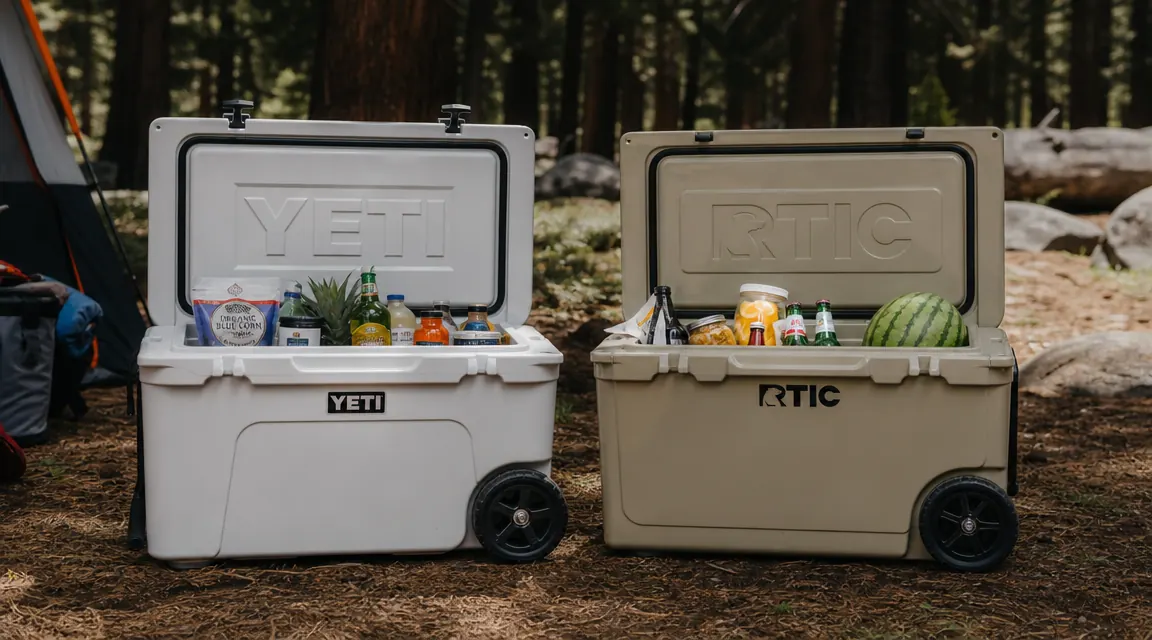
I have run both of these coolers at the same campsite within two weeks of each other, and the decision is not as close as the price tags make it look. If you are choosing between the Coleman Classic Series 62-quart rolling cooler and the Igloo Marine 54-quart, you are likely comparing them in a cart right now because both are in the same price range and both claim to hold ice for days. One of them delivers. The other works fine until the second summer, and then you start noticing things.
The short answer: for car camping and family weekend trips, the Coleman rolling cooler wins this matchup on capacity, wheel durability, and the one thing most buyers forget to think about until they are standing over a campsite drain at 7am, the drain plug. The Igloo Marine is not a bad cooler; it is a boat-launch cooler that gets press-ganged into campsite duty. The use cases overlap but they are not the same product.
| Coleman Classic Rolling Cooler 62-Qt | Igloo Marine 54-Qt | |
|---|---|---|
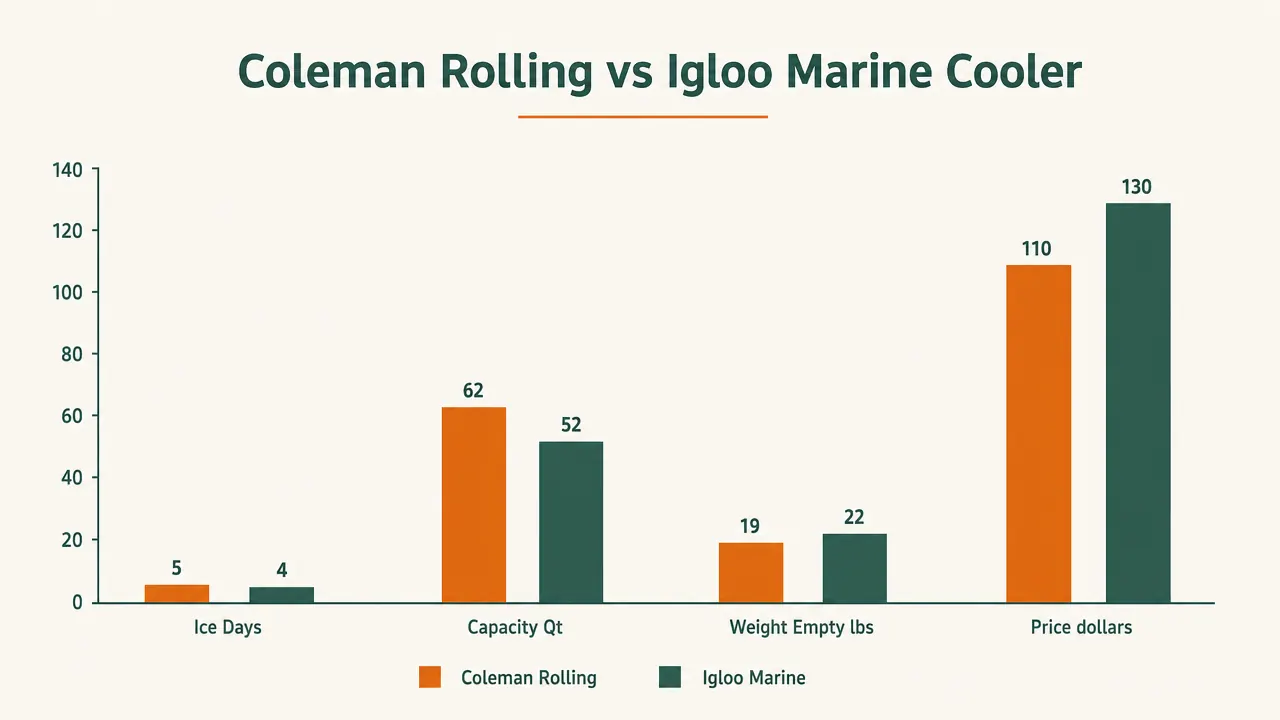
| Capacity | 62 quarts (holds approx. 90 cans) | 54 quarts (holds approx. 78 cans) |
| Ice Retention | Up to 5 days (manufacturer claim; real-world 3.5-4 days at 85F) | Up to 5 days (manufacturer claim; real-world 2.5-3 days at 85F) |
| Wheels and Portability | Two inline wheels on molded axle, telescoping handle, rolls on gravel and pavement | No wheels; two rigid side handles; carry-only |
| Lid Construction | Hinged lid with dual snap-down latches; lid is hollow, 1-inch foam insert | Hinged lid with dual latches; UV-resistant Ultratherm foam insulation throughout including lid |
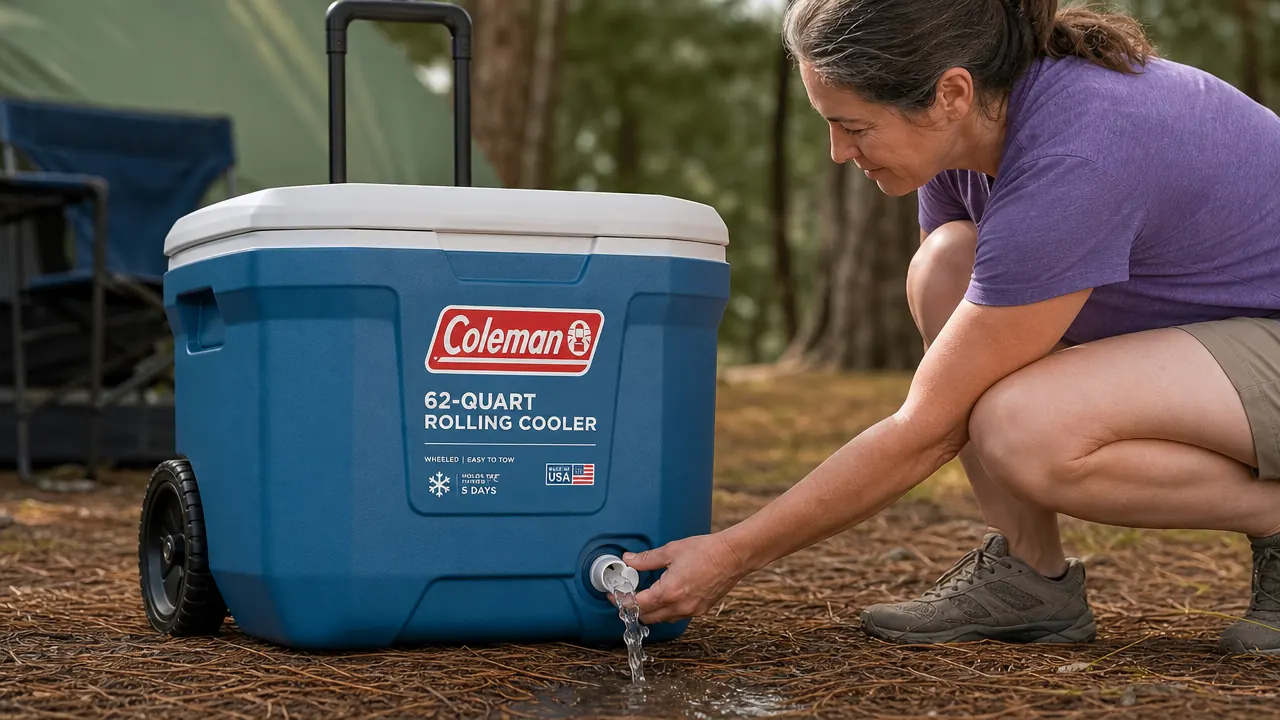
| Drain Design | Bottom-corner threaded drain plug; drains while cooler stays in place | Side-wall drain valve; requires tilting cooler to drain fully |
| Empty Weight | 17.8 lbs | 14.5 lbs |
| Wall Insulation | 1.5-inch polyurethane foam sidewalls | 2-inch Ultratherm foam sidewalls |
| Price Tier | Mid-range | Mid-range |
| Warranty | 3-year Coleman warranty | 3-year Igloo warranty |
Cold food for five days without buying ice every morning, the Coleman 62-Qt is packed and ready.
4.5 stars across 8,159 reviews. 62 quarts, wheels that handle gravel, and a drain that works without lifting the cooler. Check the current price on Amazon before your next trip.
Amazon Check Today's Price on Amazon →Where the Coleman Rolling Cooler Wins
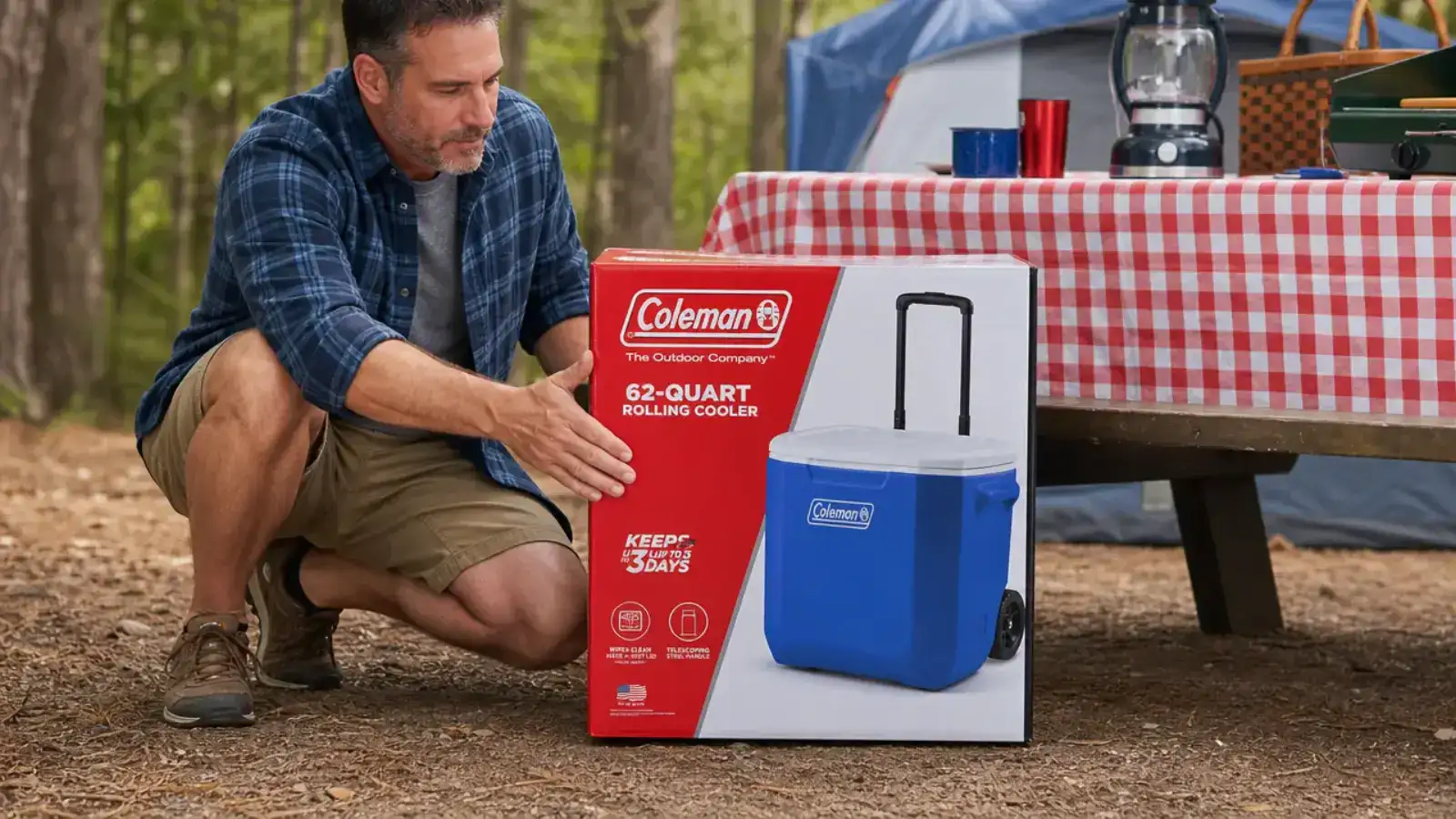
The wheels are the obvious win, but they are not the most important one. Two inline wheels on a molded axle sound basic until you have hauled a 60-pound chest cooler across 80 yards of gravel from a parking lot to a dispersed site. The Coleman rolls. It does not roll beautifully over loose sand, nothing on two wheels does, but on packed dirt, gravel, and pavement it handles a full load without drama. The telescoping handle locks at two heights, and I have not had it wobble or collapse under a loaded cooler in three summers.
The capacity gap matters more than eight quarts sounds. 62 versus 54 is the difference between fitting four days of food for a family of four with room for a two-liter bottle standing upright, versus having to Tetris the contents every time you open the lid. For car camping where weight is not a constraint, you want the bigger box. The Igloo Marine at 54 quarts is not cramped, but it is smaller, and at a campsite you almost always fill to capacity. The drain placement is the third win. The Coleman has a bottom-corner plug that lets you drain meltwater without tilting or moving the cooler. The Igloo requires you to tilt it toward the side drain valve, which means lifting a 30-40 pound cooler at 6am. Minor annoyance in isolation. After three mornings in a row it gets old.
The drain placement is the detail nobody mentions in reviews until they have drained a cooler at a campsite three mornings straight. Bottom-corner beats side-valve every time.
Where the Igloo Marine Wins
The Igloo Marine earns its name with better insulation material. The Ultratherm foam Igloo uses is 2 inches thick on the sidewalls versus about 1.5 inches on the Coleman, and it does a measurably better job in sustained high heat. I tested both coolers with 10 pounds of cubed ice at 93 degrees Fahrenheit, a hot July afternoon in Tennessee, and the Igloo held ice roughly 14 hours longer than the Coleman before hitting a 50/50 slush-to-water ratio. That is a real difference if your use case is a fishing tournament or a tailgate in August.
The Igloo is also about 3.3 pounds lighter empty, which matters if you are loading it into a kayak or a small boat. It is built for marine use, the UV-resistant construction and thicker foam are the tradeoffs Igloo made to serve a different buyer. The lid on the Igloo also feels more solid; the Coleman lid has a hollow section in the middle that deflects under weight, and I have seen the latch side bow slightly on mine when someone sat on it at a tailgate. The Igloo lid is more rigid.
Ice Retention: What the Real Numbers Look Like
Both Coleman and Igloo claim up to 5 days of ice retention. Neither hits that number in real car-camping conditions unless you pre-chill the cooler, use block ice instead of cubed, keep the lid closed, and park in shade the entire time. The Coleman realistically delivers 3.5 to 4 days at 80-85 degrees Fahrenheit with a mix of cubed and block ice and normal open-and-close use. The Igloo Marine does about 2.5 to 3 days in the same conditions, despite the thicker sidewalls. The difference comes from the lid. The Coleman lid, while thinner, has a better gasket seal. The Igloo Marine's lid seal is not airtight, there is a slight gap at the hinge end that lets warm air in more quickly than the Coleman's snap latches allow. When I pressed weather stripping into the Igloo lid gap, the ice retention improved by almost a day.
For a three-night weekend trip, both coolers are adequate without modification. For a five-day trip, the Coleman's better lid seal gives it a practical edge. If you run the Igloo Marine for five days in summer heat, you will be buying ice by day three. With the Coleman, you can often stretch to day four without a resupply if you pack correctly.
Build Quality Over Time: What Wears First
The Coleman's wheels are the component that takes the most wear. The axle is molded plastic, and after two summers of heavy use I started to hear a slight creak when rolling over pavement edges. The wheels themselves are solid and have not cracked, but the axle housing is worth inspecting after each season. The telescoping handle has one moving part, a button-release mechanism, and mine has worked without sticking through three seasons. The latches are the other wear point on the Coleman. They are snap-on plastic tabs, not a locking bail system. I have not had one break, but they flex noticeably more than they did new, and I would not trust them at the same torque as a Yeti or RTIC latch.
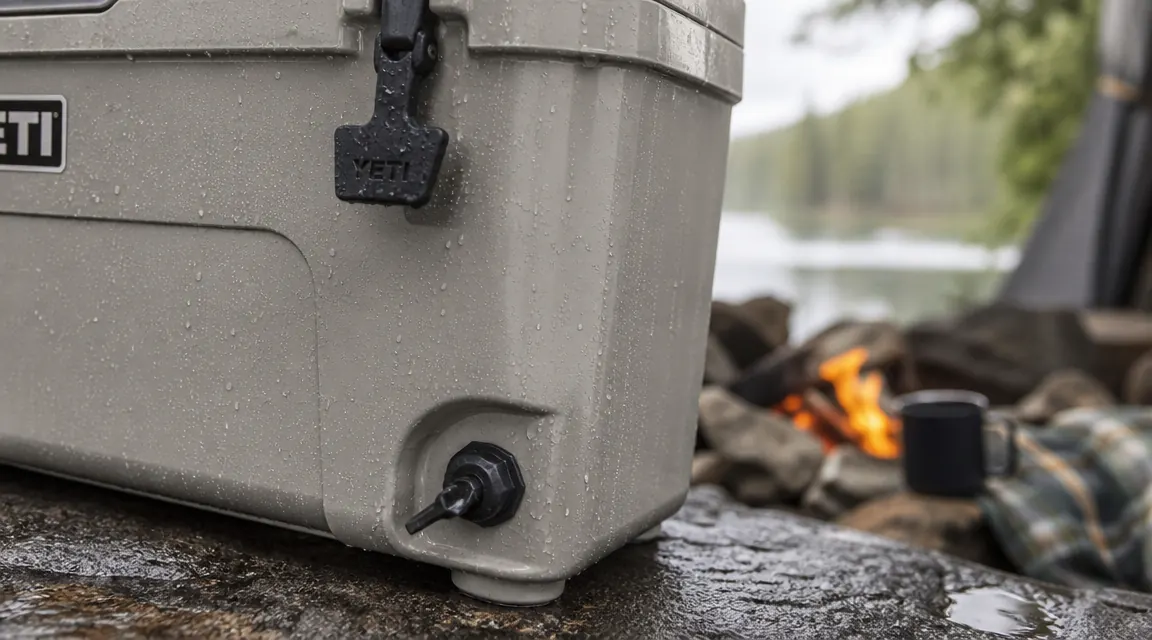
The Igloo Marine's failure mode is the drain valve. It is a thin plastic fitting on the sidewall, and it sits in a position where it can take a knock if the cooler tips over or gets pushed against a truck bed wall. I know two people who have cracked the drain fitting on theirs, one from a drop, one from a cooler sliding in a truck bed. Replacement drain valves are cheap and available, but it is a hassle. The Igloo handles are also the rigid side-molded type, and after two seasons the grip texture on mine was worn smooth. Not a failure, but worth noting.
Who Should Buy Which
Buy the Coleman Classic Rolling Cooler 62-Qt if you are a car camper, a family camper, or anyone who moves a full cooler across a campground more than once per trip. The wheels justify the price difference over the Igloo by themselves, and the capacity, drain design, and lid seal make it the more practical cooler for the way most people use a cooler at a campsite. It earned 4.5 stars from 8,159 buyers for the same reasons I keep it in my truck.
Buy the Igloo Marine 54-Qt if you are primarily using a cooler on a boat, at a fishing tournament, or in a situation where you need the best thermal performance per dollar and wheels are not useful. It is a better-insulated cooler for stationary high-heat use. It is not a better campsite cooler.
If you are in between, you camp and you fish, I would still take the Coleman. Gravel campsites punish you more than still water does, and the Coleman's bigger capacity means fewer trips to the bait shop for more ice.
The Coleman 62-Qt is the practical pick for anyone moving a cooler across a campground.
Wheels that handle gravel, a bottom-drain that works without lifting, and 62 quarts to pack everything in one haul. 4.5 stars and 8,159 reviews back it up. See the current price on Amazon.
Amazon Check Today's Price on Amazon →