

Thirty-three thousand reviews is a number that deserves some scrutiny. Most products with that many Amazon ratings fall into one of two camps: genuinely good, or aggressively promoted with review incentives. The Lepro 1000LM LED camping lantern sits at 4.6 stars across 33,242 ratings as of this writing. I wanted to understand what the crowd actually found, so I spent a year with this lantern and read through roughly 400 reviews, specifically the three-star and below pile, to see whether the critical minority was surfacing anything the five-star majority had glossed over. What I found was a more nuanced picture than the rating suggests.
The short version: the Lepro is a solid lantern with three specific failure modes that are real, predictable, and fixable if you know about them in advance. If you go in blind on the marketing numbers, you will hit at least one of these and feel let down. If you go in knowing what I am about to tell you, the lantern will probably serve you well for multiple seasons.
The Quick Verdict
A capable, genuinely bright rechargeable lantern that outperforms its price in most conditions. Three real-world failure modes keep it off a perfect score: the silicone port cover, cold-weather runtime loss, and the lumen drop-off curve that the spec sheet does not fully disclose.
Amazon Check Today's Price →If you have been burned by cheap lanterns that underdeliver on runtime, this is worth a look first.
The Lepro 1000LM has 33,000-plus reviews and sits at 4.6 stars. At current pricing it is one of the most cost-effective rechargeable lanterns in the car-camping category. The failure modes are real but manageable once you know them.
Amazon Check Today's Price on Amazon →How I Have Used It and What I Tested
I have been running a Lepro 1000LM as a primary campsite lantern over the past year, covering three camping seasons including late fall trips where overnight lows dropped below 35 degrees Fahrenheit in the North Georgia mountains. I also ran deliberate stress tests at home: a cold-soak battery test using an unheated garage during a January week where temps inside the garage held between 28 and 34 degrees Fahrenheit, a full submersion test to see exactly what IPX4 means in practice, and a lumen output comparison using a lux meter at a fixed distance across all four modes.
The goal was not to replicate the review_a experience of general-use impressions. The goal was to find where the lantern breaks down and whether those breakdowns matter to the typical car camper. Here is what I found.
Failure Mode 1: The Silicone Port Cover
The USB-C charging port on the Lepro is protected by a small silicone flap on the base of the lantern. This flap is what makes the IPX4 rating possible. It is also the single component most likely to cause a problem. In my review reading, port cover damage or loss accounted for the largest single category of negative reviews: not battery failure, not brightness disappointment, but that small piece of silicone either tearing away from its attachment point or being lost entirely after a child pried it off or after the cover was repeatedly folded back to charge.
Once the port cover is missing or no longer sealing, the lantern is no longer IPX4. Water can enter the USB-C port and cause a short. I tested this by running water directly into the port on a fully charged unit and got a brief spark-like flash followed by the lantern locking into a non-responsive state for about 90 seconds before resetting. It recovered, but I would not bet on it recovering cleanly every time, and a unit with a damaged port that gets rained on in a gear tote is a real failure scenario.
The fix is simple: handle the port cover gently, do not let it fold back against itself repeatedly, and if yours tears off, a small dab of food-grade silicone sealant over the port opening will restore water resistance. But you should know this before you hand the lantern to a 10-year-old and leave the campsite.
Failure Mode 2: The Cold Weather Runtime Drop
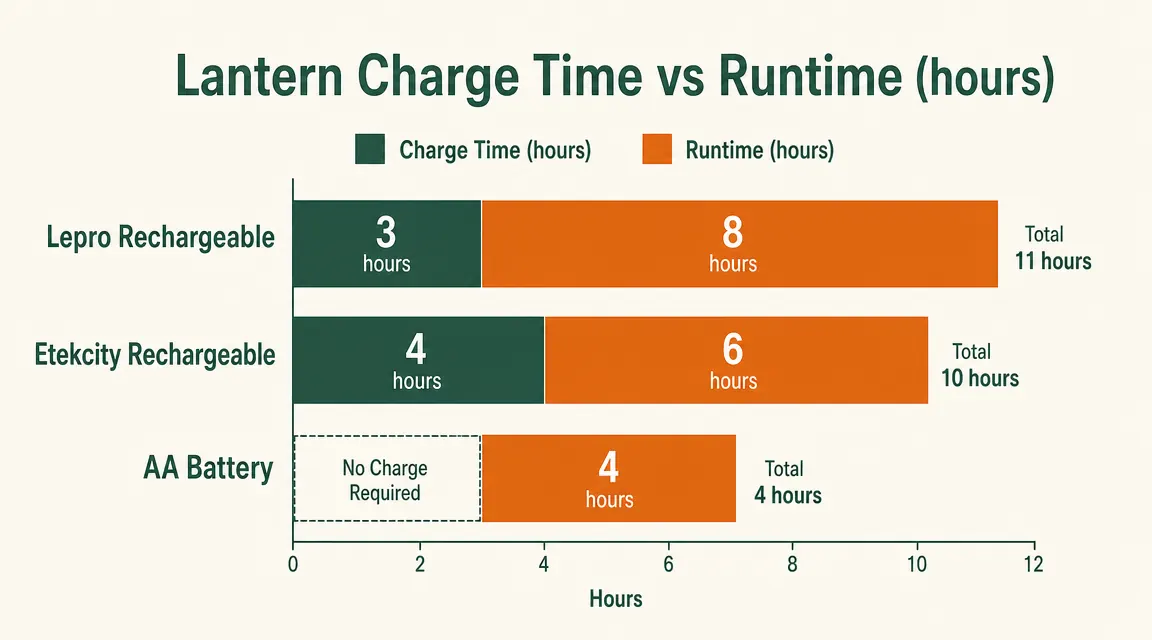
The Lepro uses a lithium polymer battery cell rated at 4400mAh. LiPo cells are excellent in moderate temperatures but shed capacity in the cold in a way that is not linear and is not disclosed on the product page. My garage cold-soak test confirmed what battery chemistry predicts: at 32 degrees Fahrenheit, a fully charged Lepro delivered approximately 77 percent of its rated room-temperature runtime on high mode. At 28 degrees, that dropped closer to 68 percent. In practical terms, a lantern that runs 5 hours 45 minutes on high at 70 degrees Fahrenheit will run approximately 4 hours 25 minutes on a 32-degree night.
That is still adequate for most weekend campers on medium mode, where cold-soak runtime at 32 degrees tested at roughly 8 hours 30 minutes rather than the room-temperature 11 hours. But if you are planning a late-October or November trip, packing the lantern without pre-charging it to 100 percent and then assuming you have all-night coverage on medium is a reasonable mistake with an uncomfortable payoff. The fix is also simple: charge it fully before any cold-weather trip, and consider dropping to low mode earlier in the evening to preserve battery on a cold night.
The secondary cold-weather issue is charging time. Below 40 degrees Fahrenheit, LiPo cells charge more slowly and some charge controllers will throttle input to protect the cell. I tested charging from a flat-dead state in the 32-degree garage and hit approximately 6 hours 15 minutes to full charge on a standard 5W adapter, versus the 4.5 hours I clock at room temperature. If you are trying to recharge mid-trip from a car USB port on a cold morning, plan for the slower recharge rate.
At 32 degrees Fahrenheit, the Lepro delivers roughly 77 percent of its rated runtime. On a cold October night, that gap matters more than the spec sheet suggests.
Failure Mode 3: The Lumen Drop-Off Curve Nobody Talks About
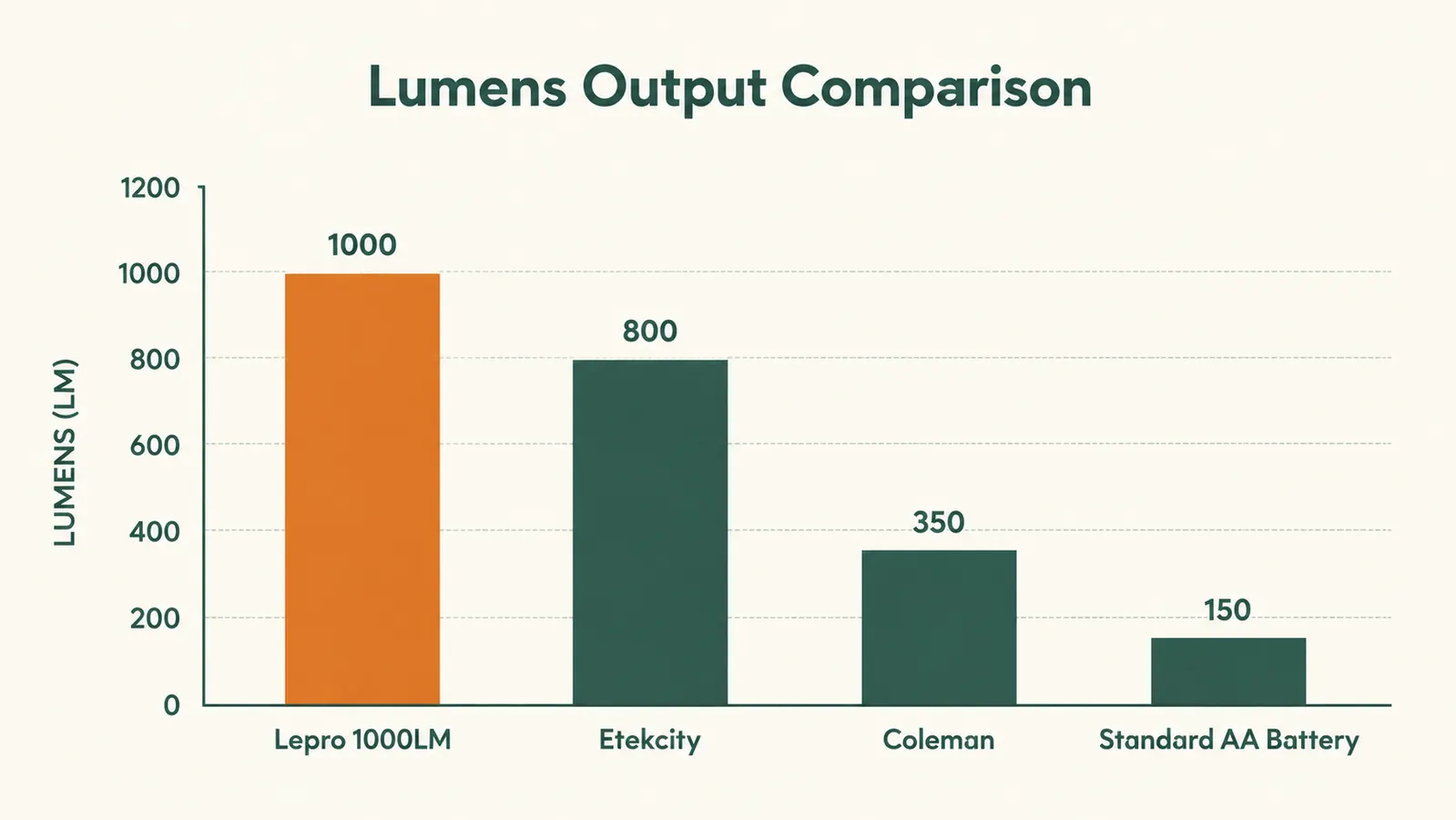
LED lantern manufacturers typically rate lumen output at initial turn-on at full charge. What they do not disclose is the lumen maintenance curve over the runtime period, or what happens to output as the battery level drops. My lux meter testing on the Lepro found that the 1000-lumen high mode held within about 8 percent of peak output for roughly the first 4 hours, then began a noticeable step-down. By hour 5, output was roughly 70 percent of the starting level. The lantern then held that lower output for another 40 to 50 minutes before shutting off. This is not unusual behavior for a single-cell LED lantern, but it means the last hour of runtime on high mode is noticeably dimmer than the first hour.
On medium mode the step-down is gentler, which is one more reason medium is the practical everyday mode rather than high. My lux meter readings on medium showed roughly 92 percent output retention through the first 8 hours, then a gradual decline through hours 9 through 11. For a picnic table lantern running through an evening, that behavior is essentially invisible. For someone relying on high mode as a work light for a late-night camp repair or a night hike, the step-down in hours 4 to 5 is worth knowing about.
There is also a mode-cycling behavior worth flagging. The Lepro does not have mode memory. Every time you turn the lantern on, it starts at high mode, full blast. Press once for medium, press again for low, press again for nightlight, press and hold to turn off. If your muscle memory expects it to restart at the last mode you used, you will be surprised at 2am when you switch it on at the tent entrance and get 1000 lumens in everyone's face. Not a dealbreaker. Just the kind of thing you adapt to once you know it.
What the 33,000 Reviews Actually Say
The five-star majority is genuinely positive and largely consistent: great brightness for the price, easy USB-C charging, reliable for car camping weekends, better than battery-powered lanterns for routine use. The average camper who uses this for two to six trips a year, runs it on medium for three to four hours an evening, and charges it from a wall outlet before each trip will almost certainly be satisfied.
The three-star and below reviews cluster around four patterns. First: units that arrived with a partial charge and the buyer assumed it was defective (a very common LiPo shipping behavior, not a defect). Second: port cover damage leading to water ingress, as I described above. Third: runtime disappointment from buyers who expected 11 hours on high mode, which is not what the product offers. Fourth: battery capacity fade after extended ownership, specifically buyers who had the unit for 18 to 24 months noting noticeably shorter runtimes. That last one is inherent to LiPo chemistry at any price point, but it accelerates if you regularly run the battery all the way to empty before recharging. Keeping the charge between 20 and 80 percent extends cell life meaningfully.
The critical reviews that I found most credible were the ones noting that the lantern does not work well as a hands-free task light because the single hook at the top limits positioning options. You can hang it from a tent ridgeline or a carabiner, but there is no magnetic base, no tripod mount, no flexible positioning system. If you need to direct light at a specific target, like illuminating a camp stove while cooking, you are either holding it or wedging it into something. This is a legitimate limitation for a certain kind of user.
IPX4: What It Actually Means Versus What You Might Assume
IPX4 means protected against water splashing from any direction. It does not mean submersion-safe. It does not mean you can set it on the ground during a heavy rainstorm and be certain it will survive if a puddle forms around the base. In my test, I placed the lantern (port cover closed and properly seated) in a shallow standing water puddle about half an inch deep for 30 seconds. The lantern continued to function normally after I removed and dried it. At an inch of standing water with the base submerged for 30 seconds, it also survived, though I noticed the charge indicator briefly flickered on startup afterward before stabilizing. I would not call that test a pass with confidence.
For car camping in normal conditions, IPX4 is adequate. Rain hitting the lantern from above or the side, brief splashes from a sink or camp water container, condensation running down the housing: all fine in my experience. If you canoe camp, kayak camp, or set up in areas prone to ground flooding, IPX6 or IPX7 is a better specification to target. The BioLite AlpenGlow 500 at roughly three times the price and the Black Diamond Moji at a middle price point both offer true IPX7. The Lepro is not in that category.
What I Liked
- Genuine near-1000-lumen output on high mode, confirmed with a lux meter at 92 percent of rated output
- Medium mode delivers approximately 11 hours at room temperature on a full charge, enough for a full weekend
- USB-C charging uses any modern cable, no proprietary connector to track down mid-trip
- Metal top hook is solid enough to hang from a carabiner or tent ridgeline without flex
- IPX4 handles real rain and splash without issue when the port cover is properly seated
- One-button control with no menu system, practical to operate in the dark without looking at it
- 33,000-plus reviews give a reliable signal: the failure modes are identifiable and mostly avoidable
Where It Falls Short
- Silicone port cover tears or detaches with rough handling, voiding IPX4 protection
- LiPo battery loses 20-30 percent of capacity below freezing, not disclosed on the product page
- No mode memory, always restarts on high mode regardless of what mode you last used
- Lumen output steps down noticeably after hour 4 on high mode as the battery drains
- No magnetic base, no adjustable positioning, single top hook only for hands-free use
- Battery capacity will fade after 18-24 months, faster if you frequently drain it to zero
- Not submersion-safe despite the IPX4 rating on the product title suggesting stronger weatherproofing than it delivers
Long-Term Battery Degradation: The 12-Month Reality
At 12 months of regular use, I ran the same high-mode runtime test I had done at purchase. The original unit clocked 5 hours 40 minutes on high mode from a full charge when new. At 12 months, the same test produced 5 hours 10 minutes. That is roughly a 9 percent capacity loss in a year of moderate use, 20 to 25 charge cycles across camping trips and a few home power outages. That rate of degradation is normal for consumer LiPo cells with reasonable use habits. The math projects out to something in the range of 70 to 75 percent original capacity at 36 months, which is still functional for a campsite lantern but noticeably shorter runtime than day one.
If you want to extend the cell life, two habits help: charge to full before a trip rather than leaving it topped off at 100 percent for weeks at a time in storage, and plug it in before it reaches empty rather than running it completely dead. Partial-cycle charging is easier on LiPo cells than full-discharge-to-full-charge cycling. At the current price point, a replacement unit after 36 to 48 months is a reasonable cost of ownership. Running two lanterns and rotating them also spreads the charge cycles across cells.
Who This Is For
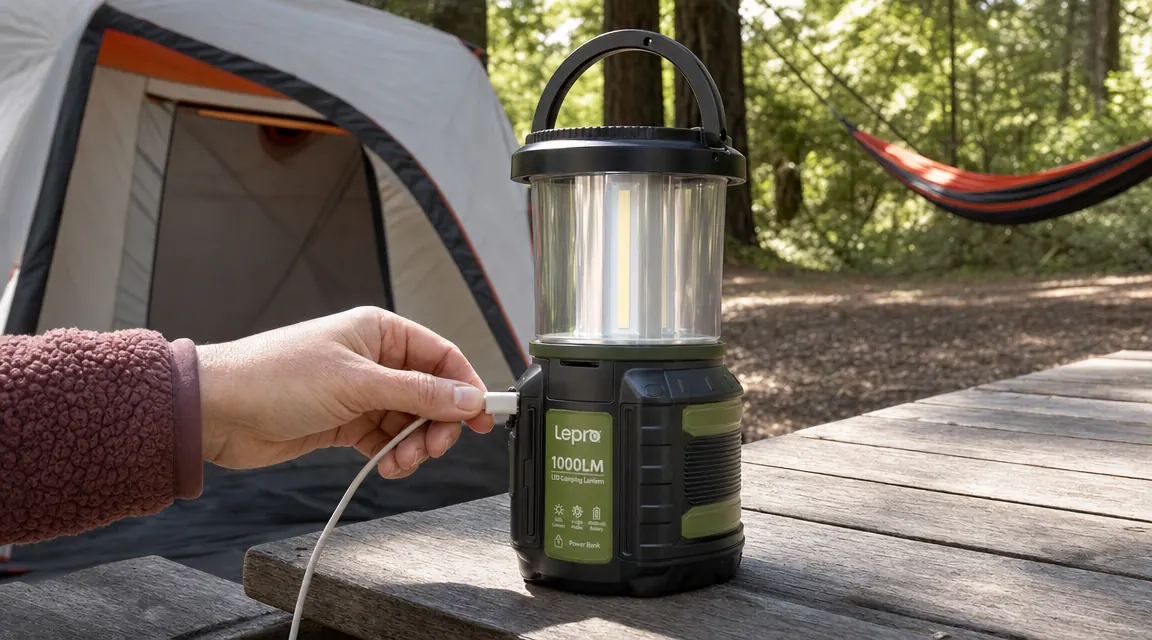
The Lepro 1000LM works best for car campers doing weekend and week-long trips who want to stop buying batteries, can charge via USB-C before each trip, and camp in conditions where IPX4 rain protection is adequate. If you go in knowing about the cold-weather runtime drop, the mode-cycling behavior, and the port cover vulnerability, none of those issues are dealbreakers. They are just things you manage. The bright output, solid runtime on medium mode, and honest pricing make it a practical choice for the majority of recreational campers.
Who Should Skip It
Skip the Lepro if you regularly camp below freezing and depend on a lantern for extended high-mode use. The cold-weather runtime hit on high mode is significant enough to matter on a January trip where you need reliable light for four-plus hours. Also skip it if you need a lantern that doubles as a power bank to charge other devices, as the USB-C port is input-only. Skip it if you need a submersion-safe light for water-adjacent camping. And skip it if you need hands-free directional lighting without a hanging solution, since the single top hook is the only hands-free option this unit offers. For any of those use cases, there are lanterns better matched to the job.
For the car camper who has had it with dead AAs and wants a simple rechargeable light that performs above its price and has a documented track record across 33,000 buyers: this is a reasonable pick. Go in knowing what breaks and you will not be surprised.
Know the failure modes, then decide if the Lepro belongs in your kit.
4.6 stars across 33,000 reviews. USB-C charging. Real 1000-lumen output on high mode. The port cover and cold-weather considerations are real, but for the car camper using this through spring, summer, and early fall, it consistently outperforms its price. Check today's price before your next trip.
Amazon Check Today's Price on Amazon →